Gordon H. Curtis (pdf)
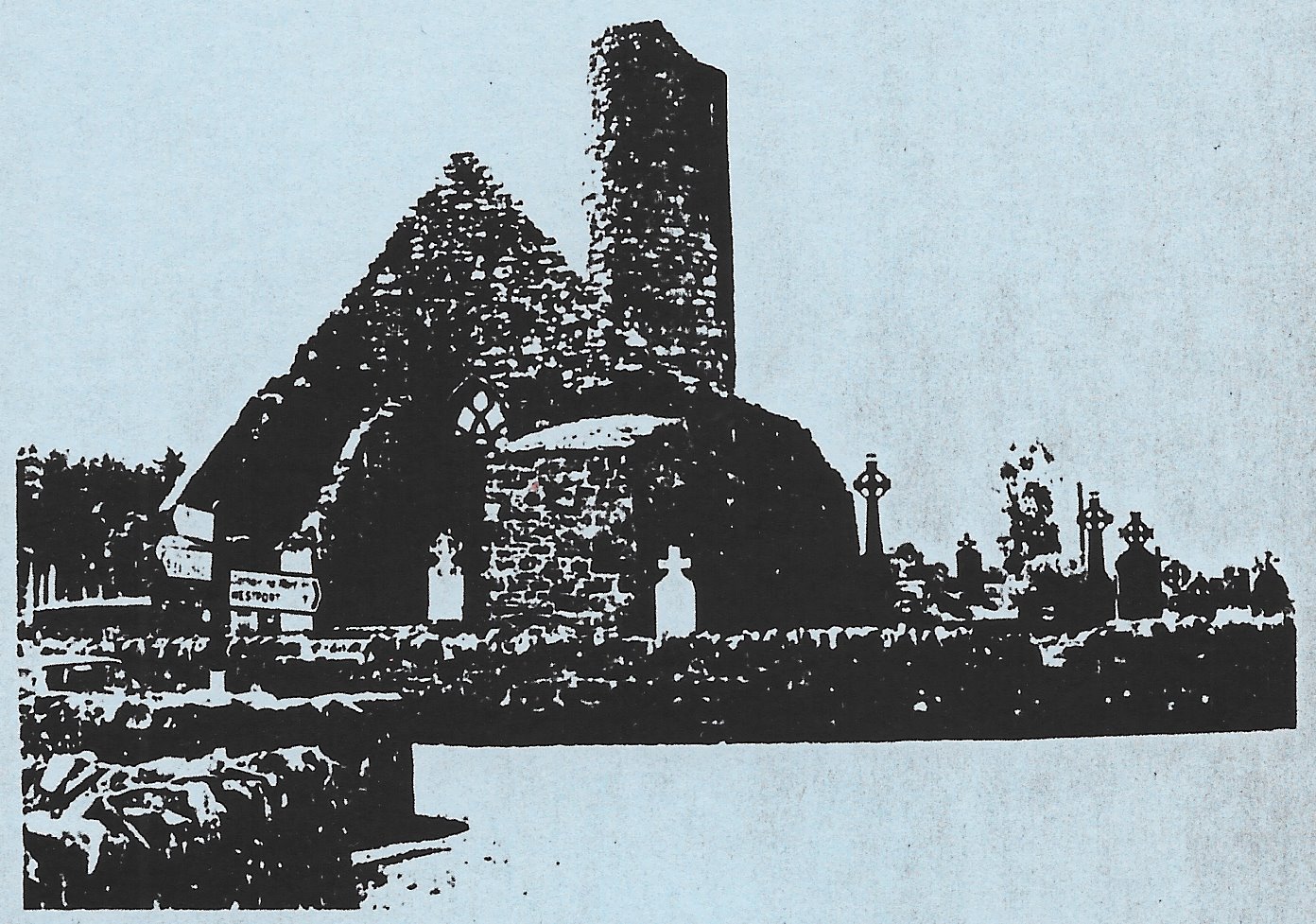
Aughagower Abbey
Achadh Fhobhair
Dedication
this work is dedicated to my wife
NOREEN BRYAN HEICK CURTIS
who brought a dowry to our marriage of inestimable richness
the friendship and love of two families
THE LAHAN FAMILY
THE HEICK FAMILY
TABLE OF CONTENTS
Chapter One – From Kings to Peasants
Chapter Two – The Great Famine
Chapter Three – Irish Life In the Gaelacht
Chapter Four – Three Acres And A Bog
Chapter Five – The Grandparents We Remember
Chapter Six – Freedom!! Freedom???
Chapter Seven – The First Fledling Flies
Chapter Eight – Anna, The City Dweller
Chapter Nine – Michael Kisses Boston’s Soil
Chapter Ten – She Didn’t Like Snakes
Chapter Eleven – We Hardly Knew Ye
Chapter Twelve – The Irish Story Teller
Chapter Thirteen – The Last Fledgling Flies
Chapter Fourteen – Another Troubled Country
Chapter Fifteen – The German Heicks
Chapter Sixteen – Joseph Florian
Epilogue
Appendix A – Irish Lineage Charts
Appendix B – German Lineage Charts
Bibliography
FORWARD
“When you arrive in ireland you’ll feel very much at home because there you’ll be among friends… You’ll see some of the world’s most beautiful scenery… The gentle hills and waterfalls around Killarney, the breath-taking Cliffs of Moher, the spectacular ruggedness of Connamara, and the delights of the Garden of Ireland, County Wicklow… you’ll have no problem with the language as English is spoken throughout Ireland…and with charming accent, melodic tones and gentle lilt…” So announces the Irish Tourist Board’s brochure to entice tourists to visit this lovely isle.
Having experienced Ireland for two weeks, we would agree with the ideal image of Ireland the Tourist Board projects.
Of Ireland Yeats wrote
the land of the faery.
Where nobody gets old and godly and grave,
Where nobody gets old and crafty and wise,
Where nobody gets old and bitter of tongue.
So we found it to be true.
It is surely a most beautiful isle. Every experience we enjoyed would have to be described in superlatives. The people are most friendly; the scenery is most spectacular.
The purpose of this visit was chiefly to visit our family who have lived in County Mayo since at least 1800. Secondly, while we were there we wanted to visit areas that we’ve read about, specifically the Dingle Peninsula. Anyone who has seen the movie “Ryan’s Daughter” will appreciate Dingle where it was filmed. There is a langauge problem there, despite the tourist brochure.
Our travels started at Shannon International Airport and our first encounter with Ireland became an encounter with countless Germans and Frenchmen. Ireland is only a few hours away from their homeland. It is a popular vacationland for “foreigners”.
We will not be concerned about the modern Ireland but of Ireland when it was Irish and not a polyglot of international visitors.
This voyage of discovery started with the children of Thomas and Honor Rice Lehen who came to the United States in the early 1900s. That generation, now dead, has left a wealth of memories deposited with the grandchildren of Thomas and Honor. It is from these recollections that this story is built.
Eight years in the making this story started with an outline of family members and the relationship of numerous cousins in both Ireland and the states. However to be satisfied with the cold, impersonal gathering of vital statistics such as birth and death dates, and who married what Irish colleen is like leaving a feast table before the desert, coffee and after-dinner cordial. We hope this story will be the cordial that warms up the happy memories of the meal. These folks are our windows on the history of two nations.
Someone has likened history to a flowing stream rushing over boulders, cascading down cliffs
meandering through green meadows. Historical events such as riots, political intrigue, governments, institutions, depressions would be the flowing stream. But history has another dimension–we call it social history. This history is not concerned with the stream that is rapidly changing direction but of what is happening on the banks of that stream. These are the people – their fears, loves, victories, defeats. It is lovers holding hands on the bank, dreaming dreams; the
farmer tending his herd, the mother feeding her young. It is the music and poetry of family living. This is the history with which this work will deal.
Ireland’s political history in all its complexity and violence is well kmown to us all. We shall not deal
with the political aspects except insofar as political action impinged directly on our Lehen family life. Politics is the stream; our family is what concerns us on the banks of that stream.
This account started with the story of the American-Irish, that is, those who emigrated to the
states. However there are egually as many Lehens in Ireland hence our visit to get as complete a story as possible. This, plus much correspondence, has given us a better knowledge of the Irish cousins. Not all that is written herein constitutes Lehen family experiences. In order to give our American readers adequate background, we’ve read widely the published literature on family life in the 18th and 19th centuries. This is a composite picture of rural Ireland. It should be emphasiszed this is not fiction. The bibliography at the end will show a wide range of authors who have written about their families who shared those two centuries with the Lehens.
We take full responsibility for any error of fact or commentary herein. The family has been generous in providing factual material and anecdotes. This has been augmented by our research in Federal Census records, Surrogate Courts, County offices around New York State. We’ve also had the assistance of the Clew Bay Heritage Centre in Westport, County Mayo. The Irish records are both sparse and difficult of access because of their unique political situation. Where we need to speculate about relationships, this will be made clear.
What follows is a distillation of much reading and research and is as reasonably accurate as we can manage.
Finally why was all this started years ago? Our belief has long been that the younger generations should be aware of their heritage. Why do genealogists use the analogy of a tree and branches? It is an accurate metaphor since everyone mentioned in this work has arrived at this point of time from a common root. His name was Michael Lehen. A good many of our family mow nothing of this Michael or his children other than our grandfather. So some of what is recorded herein will be new; some of it may be nostalgic.
We hope it will introduce our younger families to this amazing family of humorous, loving, determined, courageous, story-telling Irish cousins.
A word about the spelling of the family name might be in order. There are numerous variations even within the same family grouping. Census and parish records are suspect since spellings are usually phonetic. The most ancient spelling is Lehen. Gravestones also have Lehane and Jahan. Thomas Michael’s marriage record has Leethin. Some official Irish records have Laython. We have found the [Irish generally use Lehen and the American branch Lahan. If the spelling in this account seems inconsistent it is because we’ve chosen to use the spelling of record.
The author has found this labor of love to be most rewarding, not so much for the historical background of the Lehen family but because we’ve finally experienced the joy of meeting the Irish descendents of Michael Lehen. Our hope is that the reader will share this interest
Gordon H. Curtis
Himrod, New York
Fall, 1991